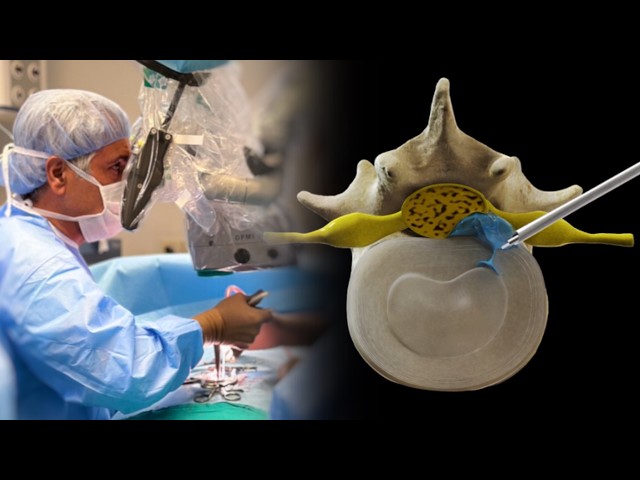
Surgery is unavoidable in approximately 3–4% of patients with a lumbar herniated disc. It is considered when other treatments have not provided enough improvement or when urgent surgery is required, for example because of progressive muscle weakness or urinary incontinence. Our team uses two techniques: microdiscectomy, which is widely performed, and full-endoscopic disc surgery, which has become increasingly common and may offer greater comfort during recovery.
Microdiscectomy (Lumbar Disc Herniation Surgery)
Microdiscectomy is the most widely used operation for a lumbar herniated disc. It is performed under general or spinal anaesthesia. Through an incision of approximately 3 cm, the surgeon moves through the muscles and removes a small amount of bone and ligament to reach the herniated disc material. The displaced material is then removed. The operation takes about 40–60 minutes, and the hospital stay is one day. See our 3D animation for a visual explanation.
Appointments & practical information
How do I book an appointment?
You can send your appointment request via WhatsApp, by phone or through the contact form. Briefly describing your complaint and the times that suit you speeds things up; we respond as quickly as possible.
What should you bring to the consultation?
If available, bring your recent MRI and CT images, previous test and surgery reports, and a list of the medication you take regularly. This makes the assessment considerably easier.
What happens at the first consultation?
We listen to your complaints and history, perform a neurological examination and review your existing images together. Treatment options are then planned with you, taking your expectations and lifestyle into account.
Second opinion
If you have been diagnosed or advised to have surgery elsewhere, you can book an appointment for a second opinion with your existing images and reports.
Reach out for your questions and appointment requests. We reply as soon as possible.
How Is Microdiscectomy Surgery for a Herniated Disc Performed?
Microdiscectomy is a minimally invasive surgical method performed with the help of a high-resolution microscope. Through a small skin incision of approximately 1.5–2 cm, the herniated area is reached directly without damaging the muscle tissue. Thanks to the 20–40x magnification provided by the microscope, the nerve root is safely retracted to the side and the herniated fragment causing the compression is meticulously removed. With this method, the surrounding tissues and bone structure are preserved to the maximum extent.
When Can I Return to Work After Microdiscectomy?
The time it takes to return to work depends on the physical demands of the patient's job. Patients who work desk jobs or do light work can generally return to work 10 to 14 days after surgery. For occupations requiring heavier physical activity, this period can extend up to 4 to 6 weeks.
How Long Should I Wear a Brace After Microdiscectomy?
Since the microsurgical method involves minimal intervention to the muscle and bone tissue, most patients do not need to wear a brace.
How Many Days After Microdiscectomy Can I Get Up on My Feet?
After microdiscectomy, our patients can generally get up on their feet and start walking approximately 4-6 hours after surgery. The day after surgery, they are able to climb stairs and take short walks, and are discharged in that condition.
When Can I Return to Sexual Activity and Sports After Microdiscectomy?
Light-paced walking can be started the day right after surgery. Return to sexual activity is generally permitted after the 2nd week. Swimming and light exercises can begin in the 4th week, while strenuous sports activities and competitive sports should be planned after the 3rd month, under the surgeon's supervision.
What Is the Difference Between Microdiscectomy and Open Surgery, and Why Is It Safer?
In open surgery, a larger incision is made and the muscles are stripped extensively from the bone, which increases post-operative pain. In microdiscectomy, on the other hand, the nerves and blood vessels are seen very clearly thanks to the microscope. This high level of visualization minimizes the risk of nerve damage, reduces bleeding, and lowers the risk of infection. The recovery process is much faster and more comfortable.
In Which Situations Is Microdiscectomy Essential?
In severe pain that does not respond to medication, rest and physical therapy, when progressive loss of strength develops in the leg or arm (risk of paralysis), when bladder and bowel control is impaired, or when MRI findings show severe compression of the nerve root, microdiscectomy is essential as the gold-standard treatment.
Are Stitches Used in Microdiscectomy, and Does It Leave a Scar?
Cosmetic (dissolvable) sutures are generally used in microdiscectomy, so there is no need for the hassle of having stitches removed. Since the incision made is very small (2 cm on average), once healing is complete it leaves a mark that is almost unnoticeable.
Is Microsurgery an Effective Solution for Ruptured Herniations?
Yes, it is definitely the most effective solution. The term "ruptured herniation" refers to disc material overflowing into the spinal canal. With microsurgery, these fragments are located under the microscope with millimeter precision and the nerve root is completely relieved.
Is There a Risk of Being Left Paralyzed After Microdiscectomy Surgery?
Thanks to technological capabilities and microsurgical experience, this risk is well below 1% in modern medicine. The detailed visualization provided by the microscope ensures the preservation of nerve tissue, maximizing safety.
What Percentage Is the Risk of Nerve Damage?
In the literature, the risk of nerve damage for microdiscectomy is around 1%. However, with surgical experience and advanced technological equipment, this risk is reduced to statistically near-negligible levels.
How Much Does the Use of a Microscope Reduce This Risk?
The use of a microscope magnifies the fine nerve fibers and blood vessels that cannot be seen with the naked eye by 20-40 times, offering the surgeon a clear roadmap. This is the most critical factor that significantly reduces the risk of nerve injury compared to open surgeries.
During Microdiscectomy Surgery, Is Only the Herniation Removed, or Is Bone Also Removed?
The main goal is to remove only the herniated tissue that is causing the compression. In lumbar herniations, a very small portion of bone may need to be shaved (laminectomy/laminotomy) to reach the nerve root and decompress the area; in cervical herniation surgery, generally no bone is removed at all. This procedure does not compromise the stability of the spine.
Can the Herniation Rupture Again From the Same Spot After Microdiscectomy?
In the world literature, the recurrence rate after microdiscectomy is between 5-10%. Paying attention to lifestyle after surgery, weight control, and lower back exercises are the most important factors in minimizing this risk.
Is It Normal for Leg Pain to Continue for a While After Microdiscectomy Surgery?
Yes, it is normal. In a nerve root that has remained under pressure for a long time, there may be some swelling and a sensation of pain that we call "nerve memory." Depending on the nerve's healing process, this pain gradually decreases and disappears within weeks.
Which Exercises Are Done After Microdiscectomy Surgery?
In the first weeks, only short walks are recommended. From week 4 onward, depending on the operated area, special isometric exercises are started that strengthen the lower back-abdominal or neck-arm muscles and increase the flexibility of the spine. The ideal exercise program should be planned individually.
How Many Hours After Microdiscectomy Surgery Can I Get Up on My Feet?
After the effect of general anesthesia wears off, our patients can generally take their first steps, accompanied by a healthcare professional, 4 to 6 hours after surgery.
If the Herniation Recurs After Microdiscectomy Surgery, Is a Second Surgery More Difficult?
In lumbar herniations, second operations require somewhat more care due to tissue adhesions (fibrosis); however, for an experienced microsurgeon this can be managed successfully, and when necessary the nerve root can be safely decompressed again with revision microsurgery. In cervical herniation surgery, since the disc is usually removed completely, no recurrence occurs at the same level.
How Many Hours Does Microdiscectomy Surgery Take?
A single-level microdiscectomy operation is completed, on average, in 45 minutes to 1.5 hours, depending on the patient's weight and the structure of the herniation.
What is fully closed endoscopic herniated disc surgery?
It is the most advanced closed surgical method, performed with the help of an endoscope (camera) inserted through the spine's natural openings or through a hole of about 0.8 cm (the width of a pen). The muscle tissue is never cut; it is only spread apart to reach the herniation.
What is the difference between fully closed herniated disc surgery and microsurgery?
While microsurgery involves an incision of about 2 cm, in the endoscopic method this is under 1 cm. In microsurgery, a small amount of tissue stripping is still performed, whereas in the endoscopic method the tissues are not damaged at all. This results in almost no post-operative pain and a much faster recovery.
Are stitches used for endoscopic herniated disc surgery?
Since the incision is very small, usually only a single stitch is placed, or it is simply closed with a piece of tape. No suture scar remains.
How safe is the camera technology used in endoscopic herniated disc surgery?
The high-resolution cameras used visualize the area while continuously irrigating it with saline. This clean, clear image gives the surgeon the ability to see the nerve structures down to the finest detail, providing maximum safety.
Can every type of herniation be operated on with the fully closed endoscopic method?
Today, thanks to advances in technology, the vast majority of herniations can be treated with the endoscopic method. However, in cases accompanied by very advanced spinal canal stenosis or bone anomalies, microsurgery may be preferred.
Can ruptured herniations or fragments that have fallen into the spinal canal be removed with the endoscopic method?
Yes, free fragments within the canal can be successfully removed through transforaminal (from the side) or interlaminar (from behind) approaches.
How long do I need to stay in the hospital after fully closed herniated disc surgery?
After endoscopic surgery, patients are generally discharged the same day or within 24 hours.
Is it possible to have endoscopic herniated disc surgery without general anesthesia?
Yes, in some suitable cases, it is possible to perform this surgery under spinal or local anesthesia, while talking with the patient during the procedure.
How big is the scar from endoscopic herniated disc surgery?
It is a scar of approximately 7-8 millimeters; once healed, it generally becomes barely noticeable.
When do patients who have fully closed herniated disc surgery start walking, and when can they shower?
Walking begins 2-3 hours after surgery. Thanks to special waterproof dressings, our patients can shower starting from the 2nd day.
What is the return time to an active sports life or a demanding work pace after endoscopic herniated disc surgery?
Since tissue damage is minimal, the return to sports is faster compared to microsurgery. It is possible to return to light sports within 2-4 weeks, and to a professional level in the 2nd month.
Is there back pain or muscle spasm after endoscopic herniated disc surgery?
Since the muscles are not cut, surgical-site pain and muscle spasm are felt much less compared to other methods.
Is the risk of recurrence lower after endoscopic herniated disc surgery compared to microsurgery?
In the literature, recurrence rates are similar to microsurgery (around 5%). However, the advantage of the endoscopic method is that a second intervention can be performed much more easily in the event of a recurrence.
What is the success rate of endoscopic herniated disc surgeries, and who should perform them?
The success rate is at the level of 90-95%. These surgeries should be performed by neurosurgeons who have received specialized training in endoscopic surgery and have extensive case experience.
What Are the Conditions That Require Herniated Disc Surgery?
Loss of strength in the leg, development of foot drop, urinary incontinence, sexual dysfunction, and severe pain that does not resolve despite at least 6 weeks of conservative treatment (medication, rest, physical therapy) are surgical indications.
What Happens If a Herniated Disc Is Not Operated On?
If the pressure on the nerve continues, permanent paralysis, chronic unrelenting pain, muscle wasting in the leg, and serious loss of quality of life can occur.
What Are the Risks of Herniated Disc Surgery?
As with any surgical procedure, there are risks of infection, bleeding, cerebrospinal fluid leakage, and a very low rate of nerve damage. However, with microsurgery and endoscopy, these risks are minimal.
What Is the Recovery Process After Herniated Disc Surgery?
Walking begins on the first day, the suture area closes by day 10, and return to social life is achieved by day 15. Complete tissue healing takes about 6 weeks.
Does a Herniated Disc Recur After Surgery?
Surgery only removes the existing herniation. If spinal health is not taken care of, the risk of recurrence from the same or a different level always remains between 5-10%.
What Is the Success Rate of Herniated Disc Surgery?
With the correct diagnosis and microsurgical or endoscopic surgeries performed by skilled hands, the success rate is above 95%.
Can I Travel by Plane or Bus After Herniated Disc Surgery?
Generally, short flights are permitted 1 week after surgery, and bus travel is permitted 2 weeks after surgery, provided that a break is taken every 2 hours.
Can I Perform Prayer (Namaz) After Herniated Disc Surgery?
For the first 4-6 weeks after surgery, it is recommended to perform prayer while seated on a chair. Once complete tissue healing has taken place, prayer can be performed in the normal manner, without excessively straining the spine.